Aims and Scope
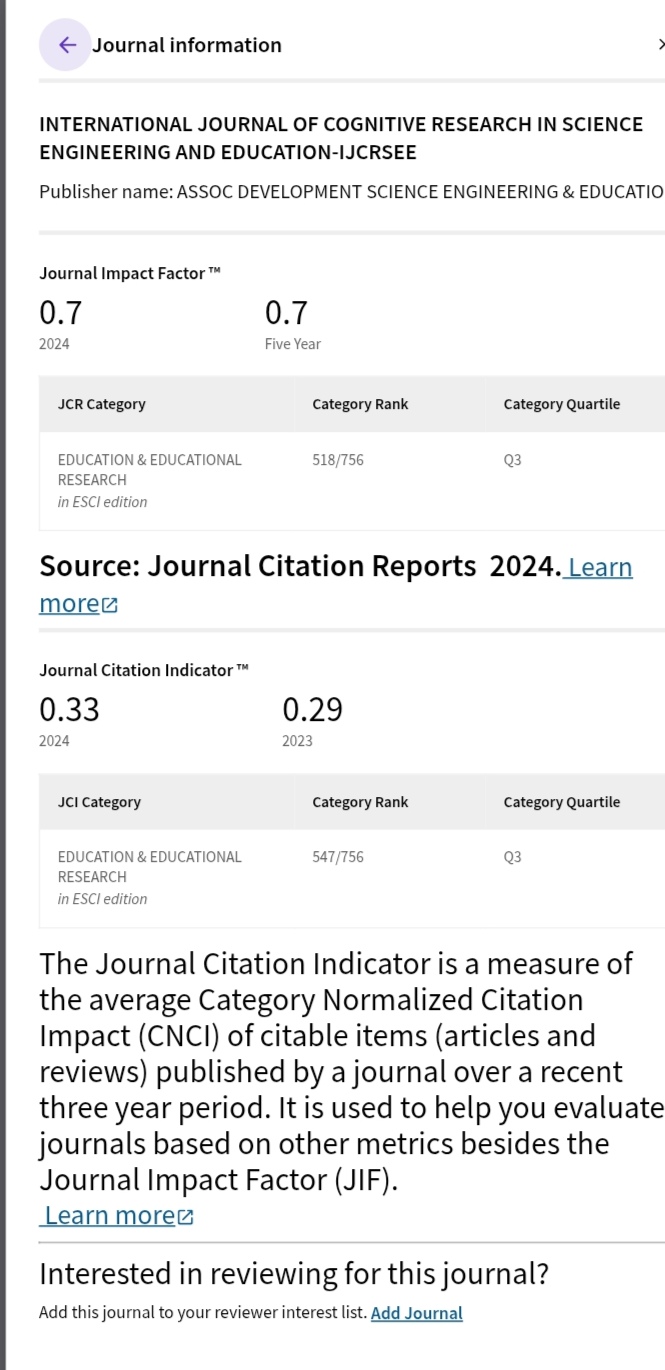
IJCRSEE aligns its editorial and thematic profile with the Social Sciences Citation Index priorities in cognitive and educational research.
The International Journal of Cognitive Research in Science, Engineering and Education (IJCRSEE) is an international, peer-reviewed, open access journal dedicated to advancing interdisciplinary research at the intersection of cognitive science, educational research, and related social sciences.
The journal aligns its editorial and thematic profile with the priorities of the Social Sciences Citation Index in the field of Education & Educational Research. IJCRSEE publishes rigorous empirical studies, theoretical contributions, systematic reviews, and methodological innovations that enhance understanding of cognition, learning processes, instructional design, and the societal implications of educational transformation.
The journal particularly encourages research that demonstrates methodological rigor, theoretical advancement, analytical depth, and international relevance across diverse cultural and institutional contexts.
CORE THEMATIC AREAS
IJCRSEE welcomes contributions within the following integrated domains:
Cognitive Science and Learning
• Cognitive mechanisms of learning and instruction
• Educational psychology and neuroscience of learning
• Memory, attention, perception, and metacognition in education
• Forensic psychology in educational and developmental contexts
• Forensic psychology, Criminology & Penology
• Cognitive and behavioral assessment in forensic and institutional settings
Artificial Intelligence and Intelligent Education
• AI-driven learning systems and intelligent tutoring
• Learning analytics and educational data science
• Adaptive learning environments and cognitive computing
• Human–AI interaction in educational settings
• Ethical and societal implications of AI in education
Technology-Enhanced and Digital Education
• Digital pedagogy and instructional technologies
• Online and blended learning environments
• Digital transformation of educational systems
Education, Culture, and Society
• Sociocultural dimensions of learning
• Identity, media, and communication in education
• Global and comparative education research
• Educational policy, governance, and innovation
Interdisciplinary Methodological Innovation
• Mixed-method and data-intensive research designs
• Computational approaches in educational research
• Evidence-based and experimental studies
EDITORIAL AND SCHOLARLY POSITIONING
IJCRSEE aims to serve as a platform for globally relevant scholarship that bridges cognitive science, educational research, and emerging technologies while maintaining high analytical and empirical standards.
The journal seeks contributions that expand theoretical frameworks, introduce methodological innovation, and provide meaningful implications for educational practice and policy. Research integrating cognitive sciences with artificial intelligence and data-driven methodologies is particularly encouraged.
All submissions are published in English and undergo a rigorous double-blind peer review process involving a minimum of two independent reviewers.
IJCRSEE promotes international diversity, citation integrity, and adherence to recognized global standards of scholarly publishing.